Laerdal Laerdal Centers of Educational Excellence
 
Home > Service & Support > Laerdal Centers of Educational Excellence > Gordon E. Inman College of Health Sciences and Nursing

Gordon E. Inman College of Health Sciences and Nursing


Inductee


Center Gordon E Inman College of Health Sciences and Nursing
Contact Beth Fentress Hallmark, RN, MSN
Address 1900 Belmont Blvd,
City Nashville, TN 37212
Phone 615-460-6112
Website www.belmont.edu/nursing Email: Beth.Hallmark@Belmont.edu


Mission

Consistent with the Christian values of Belmont University, the mission of the Gordon E. Inman College of Health Sciences and Nursing is to improve societal health by preparing graduates to be exceptional professionals in an environment that:


  • Provides excellence in teaching and learning;

  • Shapes practice through innovation and partnerships;

  • Creates and disseminates knowledge through research and scholarship;
  • Emphasizes inter-professional collaboration; and
  • Inspires life-long learning.


Learner population – number and type of learners by discipline


Nursing: Undergraduate, 350; Graduate, 30;

Pharmacy, 75

Social Work, Occupational Therapy, Physical Therapy Students/(and faculty) participate at various levels.

Community Partners: Educators across the state, hospital educators, Hospitals and universities, Hospital and clinic administrators (LEAN Management), Primary and secondary science educators (HOSA)

Practical and applied research  in research (HCA)


Program goals

Demonstrates competency in applying problem solving methods in the nursing management of wellness and disease states across the lifespan.
Utilizes effective communication and information technology to enhance nursing practice.
Provides culturally sensitive health care for diverse populations in a variety of health care settings.
Provides quality nursing care while maintaining stewardship of human and material resources.
Provides professional nursing care management of wellness and disease states across practice environments.
Collaborates with members of interdisciplinary health care teams.
Critiques and uses research findings for applicability to nursing practice.
Demonstrates evidence of a commitment to lifelong learning in professional practice and personal development.


How do you use simulation to achieve your program goals?

Demonstrates competency in applying problem solving methods in the nursing management of wellness and disease states across the lifespan.
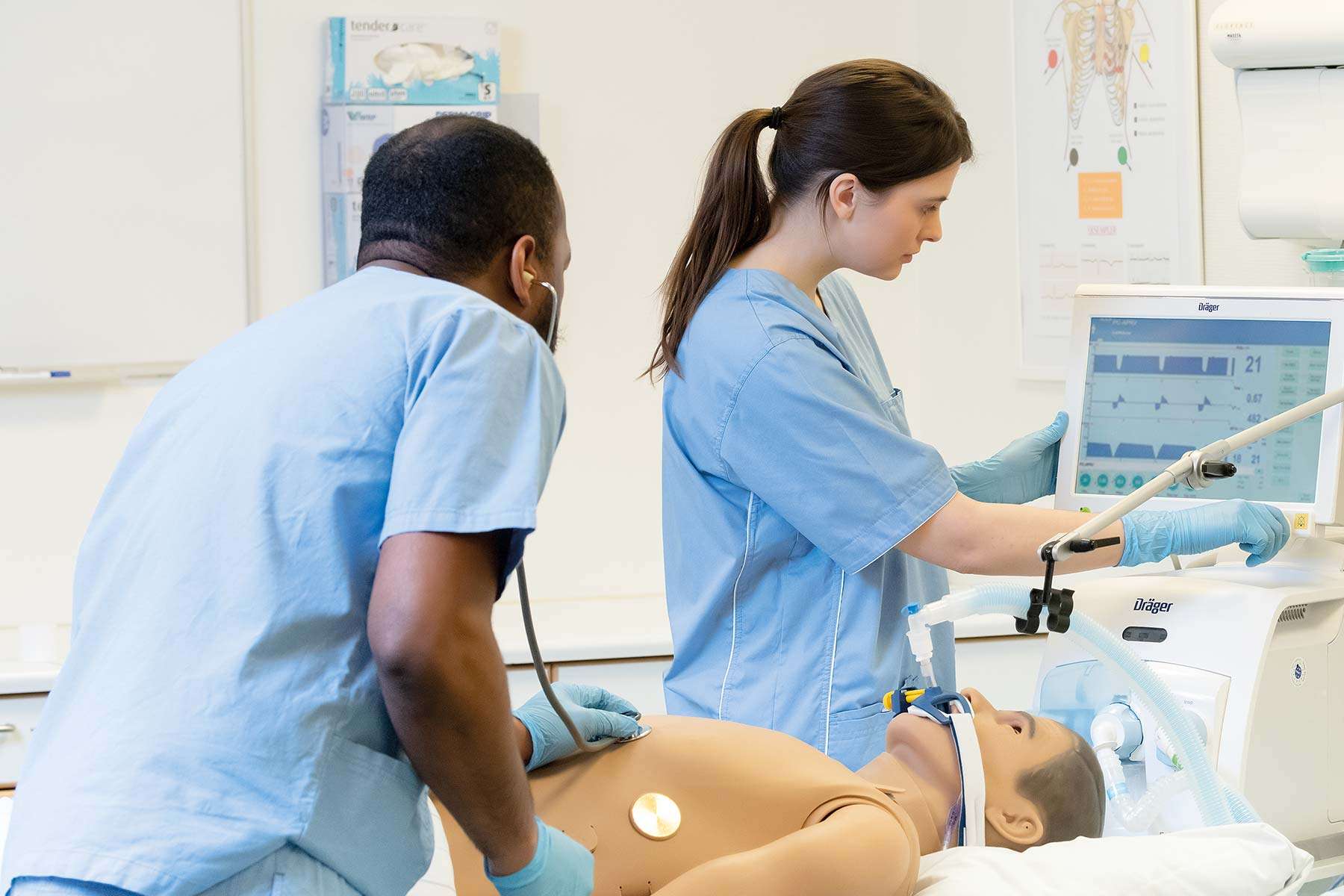
  Simulation is used throughout the nursing curriculum to give the students the opportunity to care for simulated patients with different medical diagnoses and requiring varying levels of care. The students must learn to prioritize the care of patients while performing skills that are appropriate to their program level.  We are beginning to integrate the care of patients in the community health setting and will work on such wellness activities as medication and nutrition counseling.
Utilizes effective communication and information technology to enhance nursing practice.
  Students involved in simulation must learn to communicate with members of the healthcare team. This includes telephone conversation and face to face communications.  In addition the student may need to communicate with family members in the home or at bedside.
Provides culturally sensitive health care for diverse populations in a variety of health care settings.
Simulations include cultural diverse patients where the student must make decisions about the care of the patient as related to the patient’s religious and ethnic preferences.
Collaborates with members of interdisciplinary health care teams.
Provides quality nursing care while maintaining stewardship of human and material resources
Within our simulations the students procure their supplies from a supply closet that is an exact replica of the local hospital clean utility room. In addition we discuss pricing and methods to decrease cost during our debriefing.
Provides professional nursing care management of wellness and disease states across practice environments.
Various disease processes are used throughout the curriculum focusing on situations the students may not have the opportunity to see in clinical.
Collaborates with members of interdisciplinary health care teams.
Our simulations include either actual members of PT, OT, SW, or Pharmacy or we role play these parts. In addition the students must learn to communicate with the PCP and other members of the team like RT, dietary or housekeeping.
Critiques and uses research findings for applicability to nursing practice.
Demonstrates evidence of a commitment to lifelong learning in professional practice and personal development.  


Major accomplishments including publications

NLN Laerdal AHA CPR study 2009  

Statewide Simulation Conference PIN /Robert Wood Johnson Grant  

Wagner, L.. Hallmark, B., Overstreet, M., & Farrar, C. (2008).
Tennessee nursing partnership promotes skill-advancement in simulation technology for nurse educators in Tennessee. The Tennessee Nurse, Fall 2008.  

Webcasting at Belmont University School of Nursing, Instructional Technology
Conference 2007
 

EMAR use during Code feasibility study NOV 2008 with HCA  

HCA ACLS/BCLS/PALS video/skills DEC 2008  

January 2009 Mosby Faculty Institute "Leadership and Management Simulation and Interdisciplinary Collaboration"


Areas of interest

Interdisciplinary Health Science and Nursing Simulation
Integration of simulation into the undergraduate and graduate nursing curriculum
Through Simulation Promote  community partnerships in order to improve societal health
Formation of statewide simulation alliance
Participate in research projects that investigate how simulation contributes to quality and outcomes.


© 2001-2009 Laerdal Medical. All Rights Reserved.