Preparing Learners for the Realities of Geriatric Care
As the aging population grows, nursing programs face increasing pressure to prepare learners for the complexities of caring for older adults, often with limited and inconsistent clinical exposure.
Simulation and virtual learning help bridge this experience gap by giving every learner access to realistic, repeatable geriatric care experiences before they enter practice.
Laerdal’s geriatric learning solutions are designed to help nursing students build confidence, competence, and clinical judgment through immersive experiences that reflect the realities of modern aging care.
The challenge of preparing students for geriatric care
Older adults represent a growing proportion of patients across all clinical settings. Yet many nursing students graduate without consistent exposure to the full continuum of geriatric care.
Common challenges include:
- ✓Varying clinical placements focused on older adults
- ✓Inconsistent exposure to care transitions and chronic condition management
- ✓Few opportunities to practice communication with patients and family caregivers
- ✓Minimal experience managing evolving patient needs over time
As a result, students may enter practice underprepared for the realities of caring for aging populations.
How simulation supports geriatric learning
Simulation provides a safe, structured environment where learners can practice caring for older adults without risking patient harm. Through realistic scenarios, students can develop and refine the skills required for high-quality geriatric care.
Through simulation-based learning, students practice:
- ✓Clinical judgment across acute and chronic conditions
- ✓Communication with older adults and family members
- ✓Prioritization and time management as patient needs evolve
- ✓Care coordination across settings such as hospitals, rehabilitation, assisted living, and end-of-life care
These experiences help ensure that every learner gains meaningful exposure to geriatric care, regardless of variability in clinical placements.
Geriatric simulation solutions
Laerdal offers complementary simulation modalities that allow nursing programs to prepare learners for geriatric care across virtual, immersive, and hands-on environments.

NextGen vSim® for Nursing | Gerontology
What it is:
Curriculum-integrated virtual simulation featuring 12 unfolding geriatric patient scenarios authored by the National League for Nursing.
Learners practice:
Clinical judgment, care transitions, communication with patients and families, and continuity of care as conditions evolve.
Best used when:
Programs need scalable, consistent geriatric exposure regardless of clinical placement variability.

vrClinicals for Nursing
What it is:
An immersive virtual reality experience focused on clinical judgment, prioritization, and time management in a busy care environment.
Learners practice:
Caring for multiple patients, adapting care for older adults, delegation, and responding to interruptions and changing conditions.
Best used when:
Programs want students to have a self-directed experience for the realities of workload, competing priorities, and real‑world decision-making.

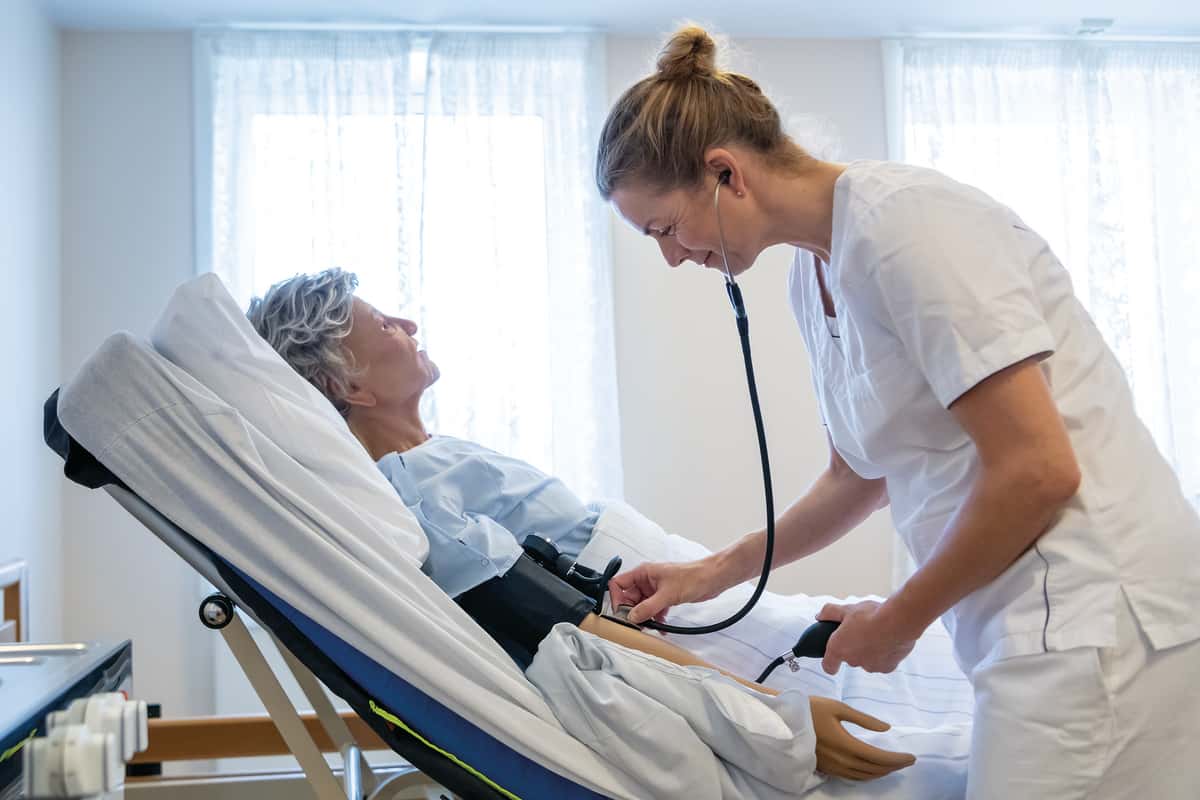
Nursing Anne Simulator Geriatric
What it is:
A full-body, high-fidelity patient simulator designed to represent an older adult.
Learners practice:
Hands-on assessment, positioning, and care delivery across the geriatric care continuum.
Best used when:
Faculty-led simulation and skills lab experiences require physical realism and scenario fidelity.
Designed for nursing education programs
Laerdal's geriatric solutions are designed to support:
- ✓Pre-licensure nursing programs
- ✓Med-surg, health assessment, and gerontology courses
- ✓Simulation and skills lab instruction
- ✓Programs preparing students for Next Gen NCLEX-style clinical judgment
Frequently asked questions
How does simulation help prepare students for geriatric care?
Simulation allows students to practice clinical judgment, communication, and care coordination in realistic scenarios that reflect the complexities of caring for older adults.
Can these solutions be used when clinical placements are limited?
Yes. Virtual and simulated experiences help ensure consistent geriatric exposure regardless of clinical placement availability.
Do these solutions support Next Gen NCLEX preparation?
Yes. The scenarios and learning experiences emphasize clinical judgment, prioritization, and decision-making aligned with current licensure expectations.
Are these solutions suitable for pre-licensure programs?
They are designed specifically to support pre-licensure nursing education and integrate into existing curricula.
5 Tips for using simulation to build readiness for geriatric care
Preparing students for the growing geriatric population requires strong clinical judgment and real-world competence, and simulation helps bridge the gap between theory and practice. In this article, we share five practical tips to help you build and assess readiness for geriatric care.