Webinar: Beyond Certification: Building CPR Competence and Confidence Through Continuous Training
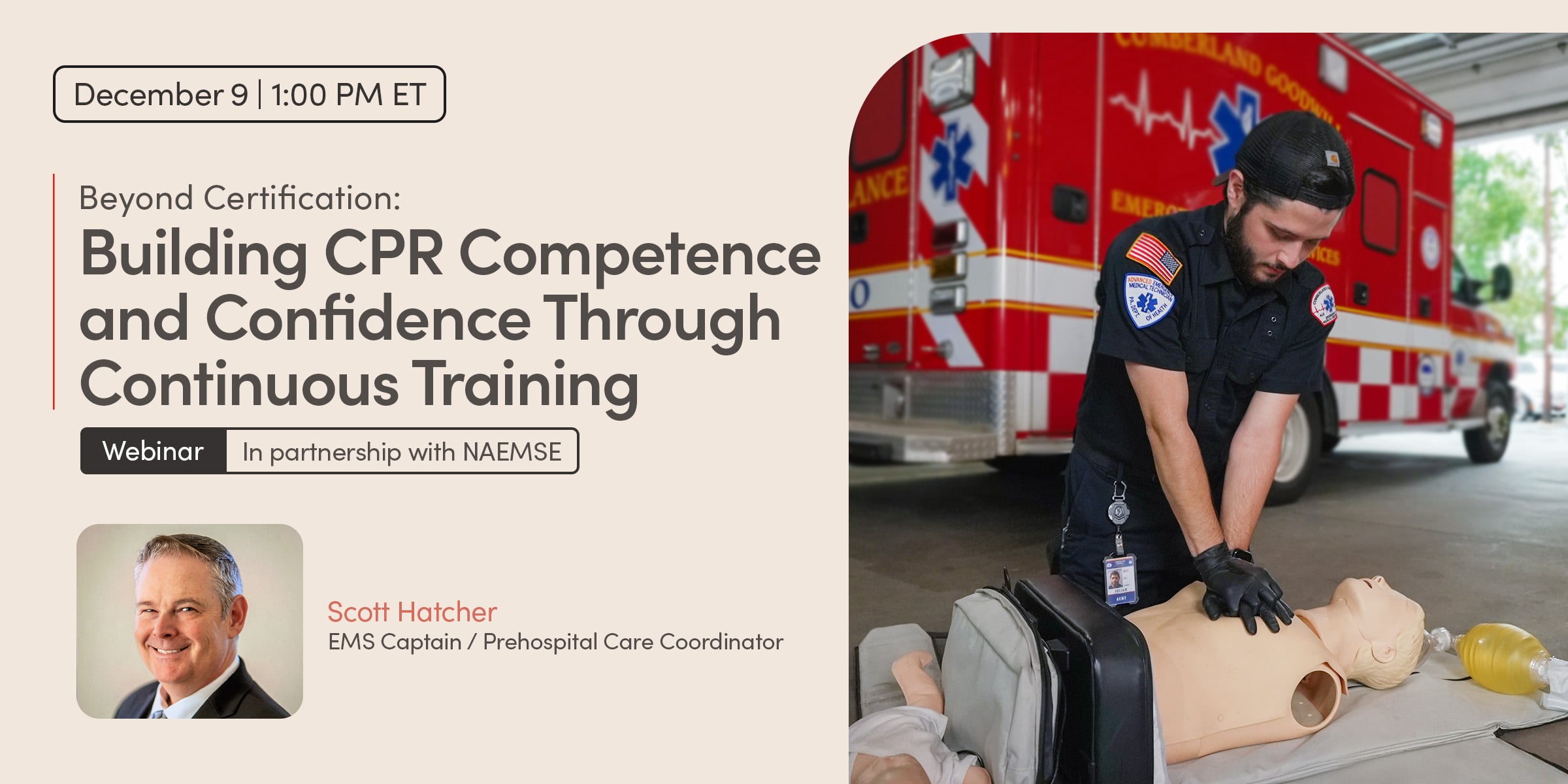
Beyond Certification: Building CPR Competence and Confidence Through Continuous Training
Many EMS providers may only encounter a handful of cardiac arrest events each year. Yet every event demands expert performance, rapid decision-making, and seamless teamwork.
How can EMS educators ensure providers remain prepared between certification cycles?
This session explores how continuous CPR education can help bridge the gap between certification and real-world performance.
Join Scott Hatcher as he shares lessons learned implementing High-Performance CPR and competency-based training programs that support:
- Improved CPR skill retention
- Greater provider confidence
- Stronger team performance
- Sustainable compliance management
- Enhanced readiness for critical events
Attend live to earn 1 CEU credit. This CE activity is accredited for one educator CEH by the National Association of EMS educators, an organization accredited by the Commission on Accreditation for Prehospital Continuing Education. CE is free for NAEMSE members and $25 for non-members.
What you'll gain
Attendees will leave with practical strategies that can be adapted to EMS educational programs, fire departments, and prehospital systems of varying sizes.
Participants will gain insights into:
- ✓Strategies to reduce skill decay
- ✓Techniques for reinforcing High-Performance CPR principles
- ✓Ways to use performance data to guide learner development
- ✓Approaches for building a culture of continuous improvement
- ✓Operational insights that support readiness and compliance
Presenter

Scott Hatcher
Scott Hatcher is an experienced EMS leader, educator, and advocate for High-Performance CPR and continuous competency development. Throughout his career, he has focused on building sustainable training programs that improve provider readiness, strengthen team performance, and foster cultures of ongoing excellence. Scott has successfully integrated quarterly CPR competency training, simulation-based practice, and data-driven performance improvement strategies across diverse EMS and educational environments, helping providers maintain critical lifesaving skills and confidence when responding to cardiac arrest emergencies.